
Bespoke Luxury Box Manufacturing: From Prototype to Production

Bespoke luxury box manufacturing is not simply about creating a box around a product. Each project must meet aesthetic, technical and economic requirements while reflecting the brand's identity and enhancing the product it contains.
Dimensions, material selection, interior fittings, opening systems, branding, finishes, quantities and budget are just some of the parameters that need to be considered before manufacturing begins.
Since 1989, TRIADE has been supporting brands in the design and manufacture of bespoke luxury boxes and premium packaging in France. From the initial technical study to production, including prototyping, each project is developed according to its intended use and the client's requirements.
Discover the main stages involved in transforming an initial idea into a finished luxury box ready for production.
1. Defining the Specifications for a Bespoke Luxury Box
The first step is to fully understand the brand's requirements and the product that will be presented inside the box.
A project can begin with detailed specifications, a sketch, a 3D rendering, an existing product or simply an initial idea. The manufacturer's role is then to transform this concept into a technically feasible solution.
What Information Should Be Provided to the Manufacturer?
The more precise the information available at the beginning of the project, the more effectively the manufacturer can assess its feasibility.
It is particularly useful to define the product dimensions, desired box dimensions, expected quantities, target budget, project schedule and overall aesthetic direction.
The opening system, interior fittings, materials, colours, logo positioning and desired level of finish should also be considered.
Can a Bespoke Box Be Developed from a Simple Idea?
Yes. A complete technical file is not necessarily required before contacting a manufacturer.
A brand can present its product, visual identity and expectations. A technical study can then be carried out to progressively define the construction, materials and manufacturing solutions required to produce the box.
2. Selecting the Right Materials for Luxury Packaging
Material selection plays an essential role in the perception of premium packaging.
A box can be predominantly made from wood while incorporating other materials to meet both technical requirements and the brand's visual identity.
Wood, Veneers and Marquetry
Wood offers a wide range of aesthetic possibilities. Natural and dyed veneers can provide very different colours, grains and textures.
Marquetry takes personalisation even further by assembling individual pieces of veneer to create a decorative composition, pattern, emblem or design specifically developed for the project.
The choice of veneer is therefore not purely aesthetic: it can become an integral part of the product's identity.

Textiles, Leather, Metal and Other Materials
A luxury presentation box is often a multi-material product.
Interiors can combine textiles, foams and other coverings, while metal components may be used for hinges, buttons, locks, plaques, logos or decorative details.
The objective is to select the most appropriate materials for the product while maintaining technical and aesthetic consistency.
3. Turning a Design into a Technically Feasible Product
A sketch or 3D rendering must then be transformed into a product that can actually be manufactured.
This stage involves studying the construction of the box, material thicknesses, assemblies, opening systems, mechanisms, interior fittings and material-specific constraints.
The Technical Development of the Box
The technical study determines how the various components will be manufactured and assembled.
It must also consider repeatability. A solution perfectly suited to a one-off piece may not necessarily be appropriate for series production.
The objective is therefore to preserve the original design intent while developing a reliable and reproducible construction.
Adapting the Project to Budget and Quantities
Expected quantities have a significant influence on technical choices.
A box manufactured in a very limited quantity will not necessarily be designed in the same way as a product intended for several hundred units.
Providing a target budget at the beginning of the project is therefore particularly useful. It allows the manufacturer to recommend materials, finishes and construction methods that are consistent with the brand's objectives.
4. Creating a Prototype of the Luxury Box
Before production begins, a prototype makes it possible to turn the concept into a physical product and assess the decisions made during the development phase.
Prototyping is particularly important when the box includes a specific construction, complex interior fittings or highly customised finishes.
Why Create a Prototype?
A prototype can be used to check proportions, dimensions, opening and closing mechanisms, product positioning and the overall ergonomics of the box.
It also provides an opportunity to evaluate materials, colours, branding and finishes.
This stage therefore makes it possible to identify any necessary adjustments before series production begins.

Is the Prototype Identical to the Production Version?
The prototype is intended to be as representative as possible of the final product, although certain manufacturing methods may evolve when moving into series production.
Producing an individual prototype and repeatedly manufacturing the same product do not always involve exactly the same constraints.
The transition to production may therefore require technical adjustments to ensure consistent quality and reliable manufacturing.
5. Validating the Prototype and Preparing for Production
Once the prototype has been presented, the brand can approve the product or request adjustments.
A colour may need to be refined, an interior modified, a logo repositioned or a mechanism adapted.
This validation stage is essential because it progressively establishes the final specifications before production begins.
From Prototype to Pre-Production
For certain projects, particularly those involving technical complexity or larger volumes, a pre-production run may be appropriate.
This provides an opportunity to validate manufacturing methods and product repeatability before launching the complete production run.
6. Manufacturing Bespoke Luxury Boxes in Small and Medium Production Runs
Once the product has been approved, manufacturing can begin.
Producing a premium box requires consistent quality from one piece to another while working with materials that may naturally present slight variations.
Combining Craftsmanship with Industrial Organisation
At TRIADE, manufacturing combines traditional expertise in cabinetmaking, veneer work, marquetry and finishing with production methods designed for series manufacturing.
This combination preserves the craftsmanship associated with high-end products while providing the repeatability required for professional and luxury-brand projects.

Can Luxury Boxes Be Manufactured in Small Production Runs?
Yes. Small production runs can be manufactured provided that the complexity, development costs and budget of the project are compatible with the number of units required.
Quantity has a significant impact on the unit price. Costs associated with technical development, prototyping, setup and any specific tooling are distributed across a larger or smaller number of products.
It is therefore advisable to communicate expected quantities from the beginning of the project so that the most appropriate solution can be studied.
7. Finishing: An Essential Stage in Luxury Packaging
The finish can significantly change the perception of a luxury box.
Two boxes using a similar construction can have completely different appearances depending on the veneer, colour and finishing process selected.
Matte Finishes
A matte finish highlights the texture and natural appearance of wood and veneer.
It can create a contemporary and understated result while protecting the surfaces of the box.
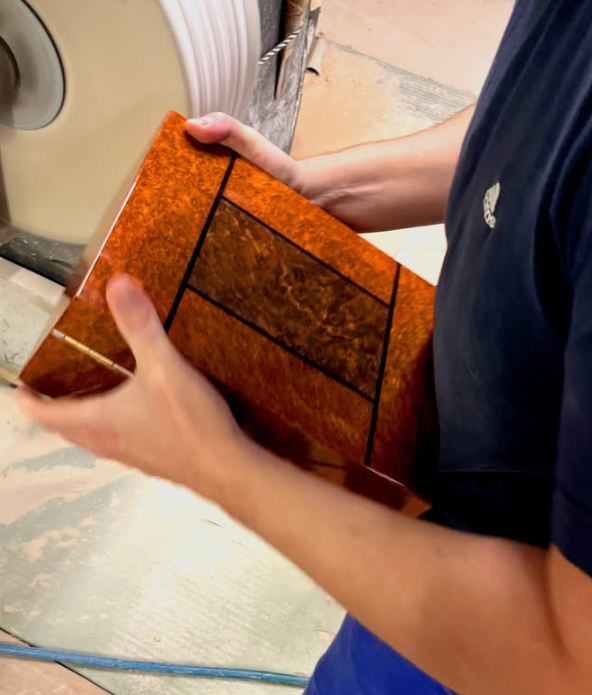
High-Gloss Finishes and Polishing
A high-gloss finish requires several successive operations to achieve a deep, even and refined surface.
Finishing and polishing contribute directly to the perceived quality of the final product.
Marquetry and Bespoke Decorative Details
Personalisation can also be incorporated directly into the decoration of the box.
Marquetry can be used to create bespoke patterns and compositions made from multiple pieces of veneer or to integrate visual elements associated with a brand.
Other techniques can also be used to incorporate logos, markings and decorative details depending on the requirements of the project.
8. Quality Control and Preparation for Delivery
Manufacturing does not end when the box has been assembled.
Each product must be inspected to verify its visual quality, finish, mechanisms, interior fittings and overall functionality.
The boxes are then cleaned, protected and packed according to the requirements of the project and the intended method of transport.
This final stage is essential to ensure that the quality achieved in the workshop is maintained until the products reach their destination.
How Long Does It Take to Develop a Bespoke Luxury Box?
There is no universal lead time for developing bespoke luxury packaging.
The schedule depends on factors such as product complexity, selected materials, sourcing requirements, technical development, the number of prototypes required, possible modifications and production quantities.
A relatively simple box and a project combining complex marquetry, multiple materials and a fully bespoke interior will naturally require different development times.
The project schedule should therefore be discussed with the manufacturer from the beginning.
How Much Does Bespoke Luxury Box Manufacturing Cost?
The cost of a bespoke luxury box depends on many factors and generally cannot be determined solely from its dimensions.
Quantity, construction, materials, veneers, interior fittings, mechanisms, personalisation, marquetry and the required level of finish can all have a significant impact on the final price.
Prototype development and any specific production requirements must also be considered.
To obtain a relevant initial estimate, brands should therefore communicate the expected quantities and target budget per unit during the first discussions.
This helps avoid developing a solution that is technically achievable but economically incompatible with the positioning of the project.
Why Choose a French Manufacturer for Bespoke Luxury Packaging?
Working with a French manufacturer provides proximity between the development, prototyping and manufacturing stages.
Technical discussions can take place directly with the teams involved in developing and producing the product, facilitating modifications and project monitoring.
Manufacturing in France also enables brands to integrate the origin of production into the story and positioning of their products.
TRIADE: From Prototype to Bespoke Luxury Box Manufacturing in France
Since 1989, TRIADE has designed and manufactured bespoke luxury boxes and premium packaging in France for brands and professional clients.
Our workshop supports projects from technical development and prototyping through to series production.
Wood, natural and dyed veneers, marquetry, textiles, metal components and other materials can be combined to create packaging that reflects the identity and positioning of each product.
TRIADE develops packaging solutions for industries including watchmaking, jewellery, luxury accessories, cigars, corporate gifts and other premium sectors.
Each project is assessed according to its design, technical requirements, quantities, schedule and target budget.
Frequently Asked Questions About Bespoke Luxury Box Manufacturing
Can a Prototype Be Made Before Ordering a Production Run?
Yes. A prototype can be used to validate the construction, dimensions, materials, interior fittings and finishes before series production begins.
What Is the Minimum Order Quantity for a Bespoke Luxury Box?
The minimum quantity depends on the project and its complexity. Development, prototyping and production setup costs need to remain consistent with the number of units required. A preliminary study can therefore determine the most appropriate solution.
What Materials Can Be Used for a Luxury Box?
A luxury box can combine a wide range of materials, including wood, natural or dyed veneers, textiles, leather depending on the project, metal and other decorative or technical materials. The selection depends on the design, intended use and budget.
Can a Brand Logo Be Integrated into the Box?
Yes. Depending on the design and materials, different techniques can be considered to integrate a logo or other elements of a brand's visual identity.
Can Bespoke Marquetry Be Created?
Yes. Marquetry can be used to create bespoke patterns and compositions from different pieces of veneer. Feasibility depends on the design, selected veneers and desired level of detail.
Can One Manufacturer Handle Both Prototyping and Production?
Yes. A manufacturer with the appropriate capabilities can manage technical development, material selection, prototyping, modifications, production preparation and the final manufacturing run.
Are TRIADE Boxes Made in France?
Yes. TRIADE boxes and bespoke packaging are designed and manufactured in France at our workshop in Montagny, near Lyon. TRIADE has been developing and manufacturing high-end boxes and packaging in France since 1989.


Comments